
Suncorp Stadium
Brisbane's redeveloped Suncorp Stadium opened in June 2003 and delivered more than a state-of-the-art venue on a modest footprint. Its clever design created instant atmosphere and a great spectator experience.
Words: Anne-Marie Willis.
Photography: Paul Bradshaw
Project Summary
The $280 million redevelopment of Brisbane’s Suncorp Stadium delivered more than a state of the art venue on a modest footprint. Its clever design also created instant atmosphere and a great spectator experience.
Stadium Event
Brisbane's redeveloped Suncorp Stadium opened in June 2003 to an enthusiastic reception from fans and players. With a seating capacity of 52,500 the new facility is the headquarters of the Brisbane Broncos rugby league team and venue for several matches in the 2003 Rugby World Cup.
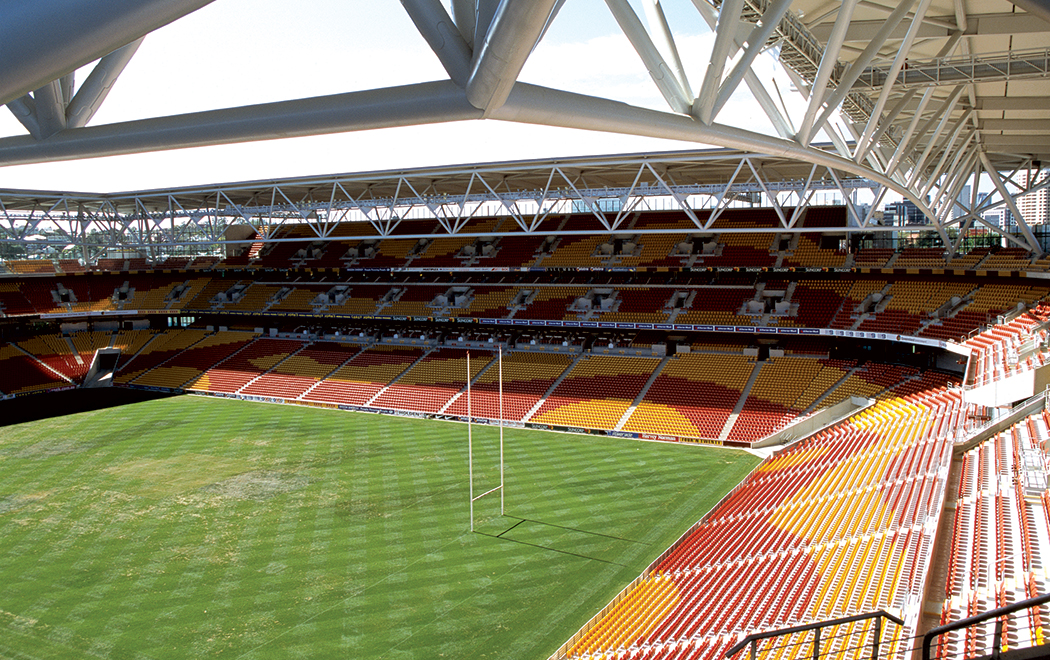
Already Suncorp Stadium has successfully hosted capacity crowds for a Rugby League State of Origin match and the August Australia vs South Africa Rugby Test.
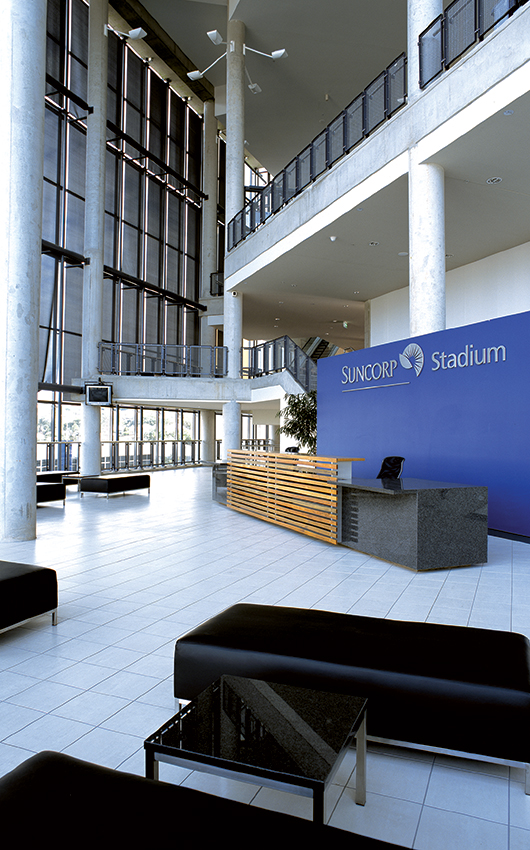
The redeveloped venue has an integrated seating bowl instead of separate grandstands. It boasts extensive members’ facilities, corporate suites, a team merchandise shop, office space for the sporting codes and stadium management. There are 2,180 dining spaces, four corner terrace open air bars and over sixty food and bar outlets. Community facilities such as an indoor basketball/netball court, gym and crèche extend the building’s use beyond major sporting events. Such features have become the norm for state-of-the-art venues.
The choice of which venue to develop and the evolution of Suncorp from the home-grown Lang Park into a world-standard football stadium has not been without controversy. The client (State Government), architects (HOK Sport+Venue+Event in association with PDT Architects), building contractor (Multiplex and Watpac as the Lang Park Redevelopment Joint Venture) and operator (Ogden IFC) have had to balance the often conflicting demands of sports organisations, players, fans, local residents and businesses.
Like the airport and the shopping mall, the stadium has become one of those hyper-real typeform spaces of the late modern world. Step off a plane into an air-conditioned airport terminal, out of a dim car park into an over-lit mall crowded with cubicles of merchandise, or pass through a stadium’s turnstiles to behold a playing pitch and crowd. Hamburg? Hong Kong? Los Angeles? You could be anywhere.
The total inward focus of the shopping mall, spatially and commercially, never allowed much room for architectural expression or engineering prowess. But airports and stadia have increasingly become stakes in games of inter-metropolitan and international rivalry. Increasingly they have had to bear the weight of political aspirations and ambitions for regional economic regeneration, with an iconic visual presence being part of the package. Of course, Olympic stadia have for a long time been architectural showpieces. But most sporting venues have until the last decade been unpretentious functional places. As sport has become more closely entwined with corporate sponsorship, the stadium has increasingly taken on civic status. HOK Sport+Venue+Event, with offices in London, Brisbane and Kansas City and more than forty stadium projects worldwide over the last decade, has been a major contributor to the rising status and visual presence of the stadium.
No longer just a playing field and spectator stands, the stadium has become an integrated entity within the worlds of corporate entertainment and commodified leisure – with dining rooms, bars, members’ lounges, corporate suites and tightly specified media facilities. Add in forecourts, purpose-built transport hubs, links to nearby urban facilities, and a stadium becomes a generator of major urban restructuring. This is very much the story of the redevelopment of Suncorp Stadium. But the price of this sophistication can be the kind of homogenisation cultural critics have labelled as hyper-reality.
The transformation of Suncorp Stadium had its genesis in 1998 when the Queensland government commissioned a study on stadium options for Brisbane. It was aware of growing competition from southern states, as witnessed by Sydney’s Olympic facilities such as Stadium Australia, the upgrades of the SCG, the MCG and Colonial Stadium in Melbourne.
The stadium study resulted in the decision to develop a rectangular pitch stadium specifically for football. Two sites were evaluated: the RNA showground and Suncorp Stadium. Suncorp won, a significant reason being that one third of the desired seating capacity could be provided by incorporating the western stand built in 1994.
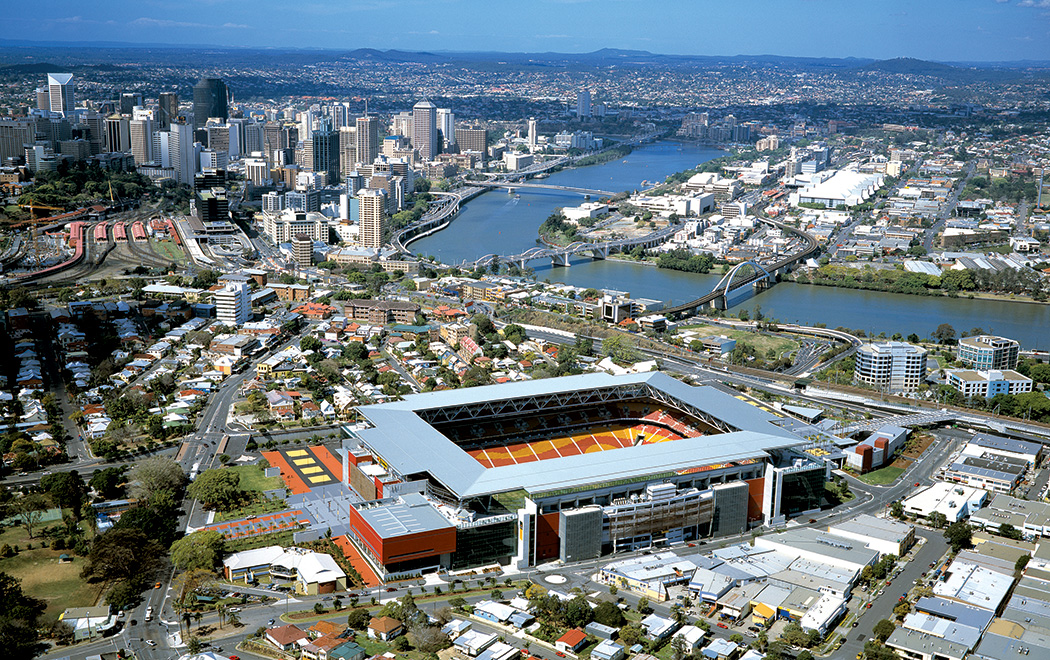
Stadia are usually built on green or brown field sites, exacerbating their sense of ‘anywhereness’. It’s a different matter with the redevelopment of a site that is already knitted deep into the existing urban fabric. Unlike Stadium Australia, which was built over a former landfill in a forgotten part of Sydney’s western suburbs, Suncorp is right in the middle of a residential and business area on the edge of Brisbane city.
Showy sculptural forms, towering projections and other expressive tropes of sports architecture were rejected by the architects. Alastair Richardson of HOK S+V+E explained that what they aimed for was a building that didn’t look particularly like a stadium and that had a consistent profile on all sides.
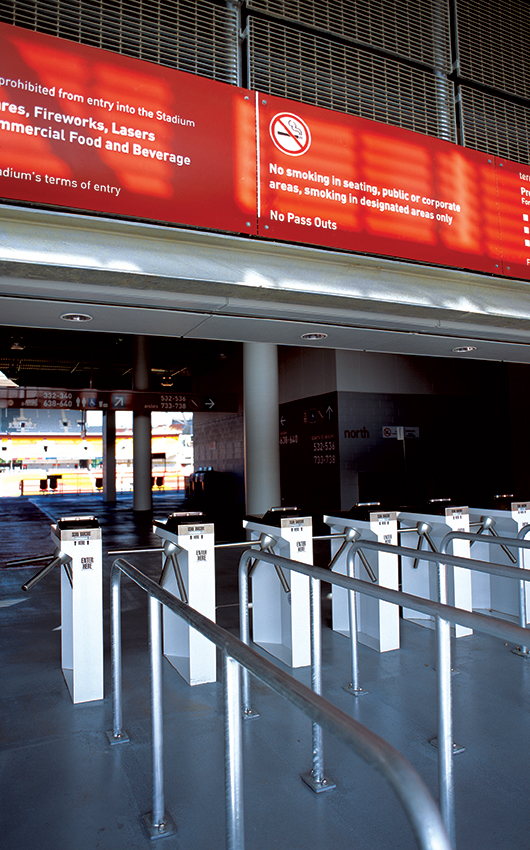
"We didn’t want structural expression extending beyond the roof, nor the roof itself to be structurally expressive. We didn’t want massing or arches. We wanted to keep it low and didn’t want it to dominate its context."
Alastair Richardson HOK Sport+Venue+Event
The extent to which Suncorp Stadium is not an iconic statement is therefore a measure of its success. This policy of restraint was partly a response to community consultation. Understandably, local residents did not want a monumentally overwhelming structure on their doorsteps. Minimising local environmental impacts has been an important theme of the whole project. Sports lighting is enclosed within the stadium, suspended on a gantry below the flat steel roof, thus minimising light spill into surrounding areas. A service road for heavy vehicles is located beneath the stadium to reduce noise and disruption to local roads.
Another important environmental requirement of the brief was that no large-scale car park would be built on-site, which meant spectators would have to use public transport or walk. To provide incentive, the cost of public transport is included in tickets, and spectator parking is not permitted within a two kilometre radius of the stadium on event days. Instead of a car park, a new bus station was built at the southern end of the stadium, a pedestrian walkway to nearby Milton station was added, and other pedestrian links were upgraded.
Walkways are also being built over the arterial roads that had, over time, cut the stadium off from the city and created the perception of it being ‘a long way out’. All of this represents significant urban restructuring, with some of the walkways still under development as part of the larger City West urban regeneration plan which aims to link the educational, sporting, cultural and residential precincts of Brisbane’s inner western suburbs to the CBD. For the building itself, the redevelopment was actually a partial rebuild. All but one of the four old grandstands were demolished, with the western stand being retained.
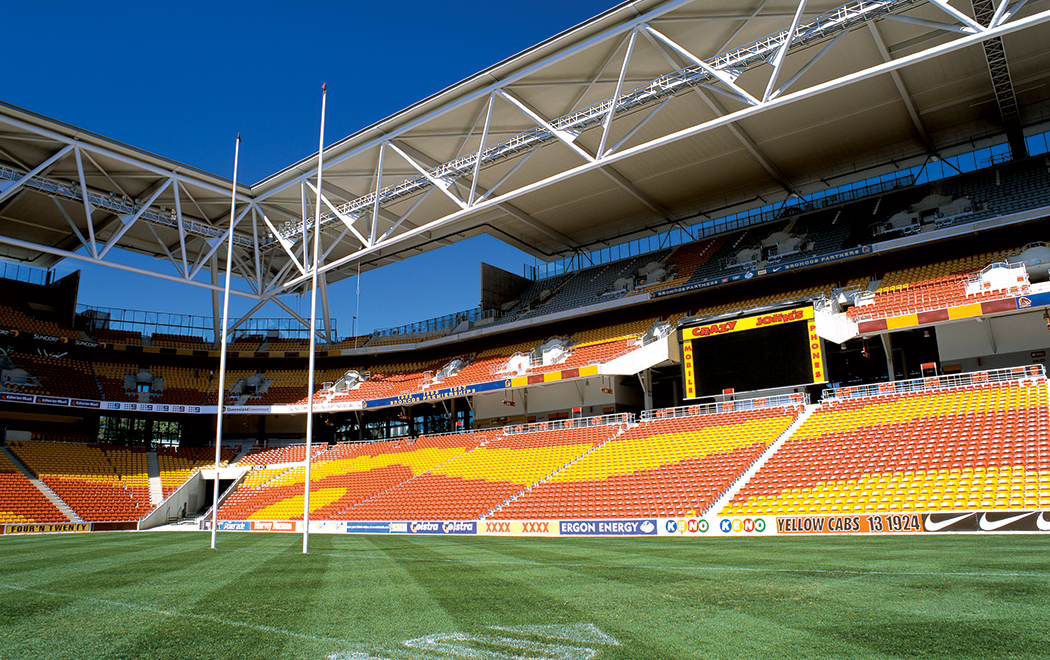
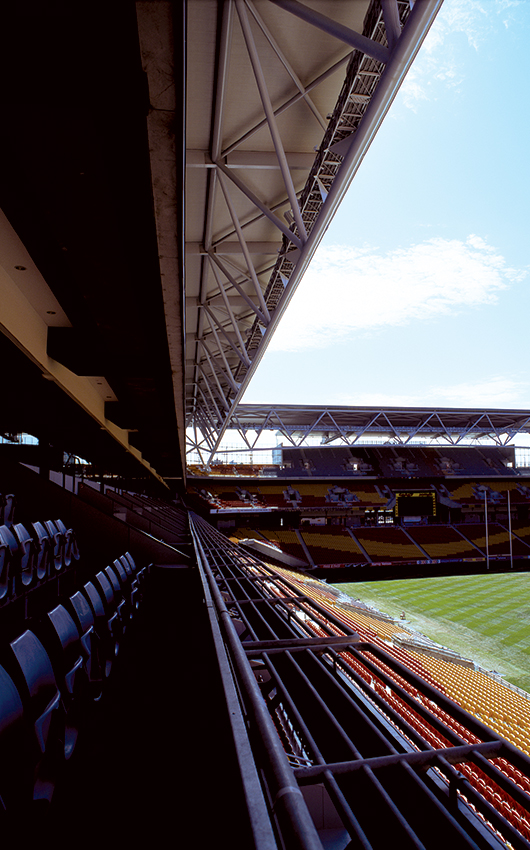
Steel has been used extensively – as framing for the grandstands and main structure (more than 1800 tonnes of steel columns), with only the corner sections in reinforced concrete. The continuous flat roof that links the four grandstands is a steel truss structure with roof cladding made from COLORBOND® steel in the colour Windspray® , rollformed in LYSAGHT KLIP-LOK 700 HI-STRENGTH® profile. More than 21,000 square metres of COLORBOND® steel and 19,400 lineal metres of purlins in GALVASPAN® steel made by BHP Steel (now BlueScope) were used for the stadium’s roof.
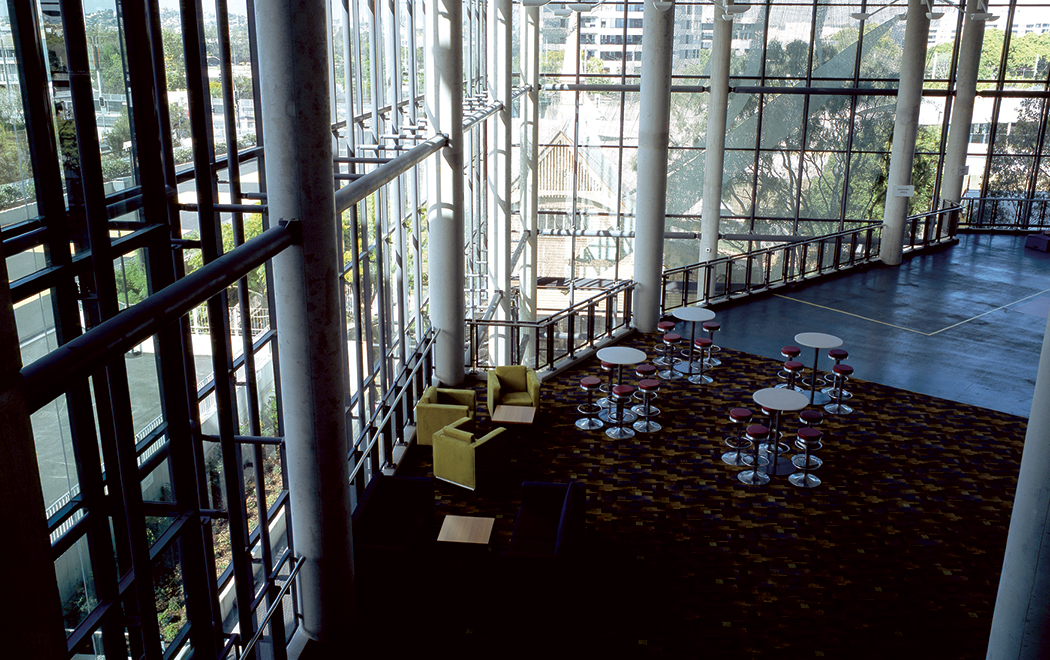
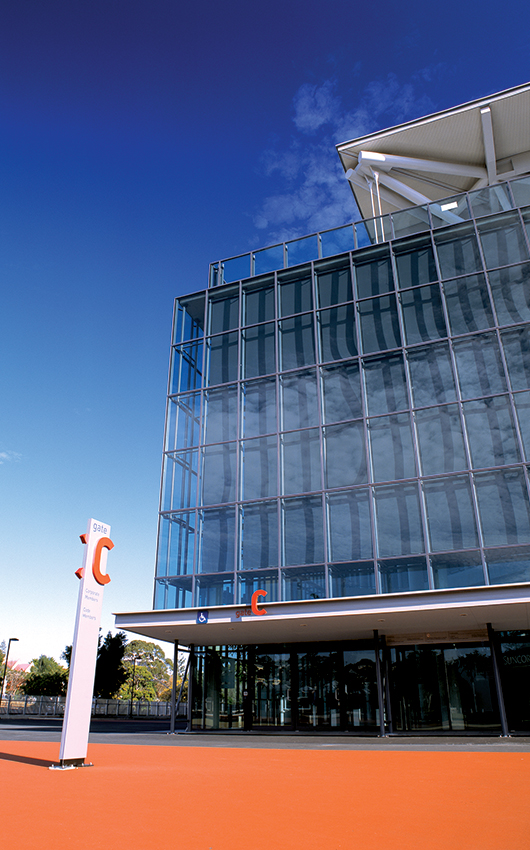
The rectangular pitch has been mirrored by a rectangular structure. This could have appeared monolithic, but measures have been taken to counter this. The corner sections are glazed atria, while the facade is carefully layered to break down the scale of the building. Notable are the recycled timber slats (milled from ironbark and spotted gum sourced from former wharves) mounted on powdercoated steel frames to form giant screens. They are positioned in front of large glazed areas enclosing dining and reception areas, assisting in minimising solar heat gain, thus reducing air conditioning loads.
Air conditioning was able to be eliminated in some of the spaces where it would normally be used, specifically, the corporate and members' reception areas. This was achieved via the use of a ventilated facade that relies on ‘the stack effect’, the timber screens and additional sun blinds on the west facade.
Queensland’s sub-tropical climate and outdoor lifestyle have informed the design of the whole facility. Inside the stadium are open air terraces and viewing galleries, outdoor barbecue grills and bars. The seating bowl itself has been designed to maximise cross ventilation of the seating area and pitch. In the upper tier, the corners have been left open, directing breezes around the seats, as well as visually breaking up the box-like form of the stadium.
Redevelopment of an existing urban environment always involves some erasure of the past in order to install the new. Ambivalence over naming reveals something of the tension between continuity and change. While Suncorp has had naming rights since it became a sponsor in 1994, the name ‘Lang Park’ is lodged in collective memory and refuses to die. This is because the place’s history as a sporting precinct stretches back more than a century, when a recreation reserve was established on former cemetery land to serve the growing working class population.
Facilities for tennis, cycling and athletics were added at different times. From the mid-1950s Lang Park increasingly became a Rugby League venue and eventually, a closed football ground, with grandstands being added every few decades. The configuration of these stands brought spectators close to the field of play. The noise of the crowd would bear down on the players – a boost for the home side and intimidating for visitors – giving Lang Park the nickname of ‘the cauldron’. Thus over time ‘Lang Park’ evolved organically, its meaning and cultural significance for players and fans accumulating as it became the site of many memorable sporting clashes. The cauldron atmosphere was part of the distinctive character of Lang Park stadium that needed to carry over into the redevelopment. This has been achieved by creating a tight seating bowl that brings spectators much closer to the on-field action than any other Australian stadium of similar capacity.
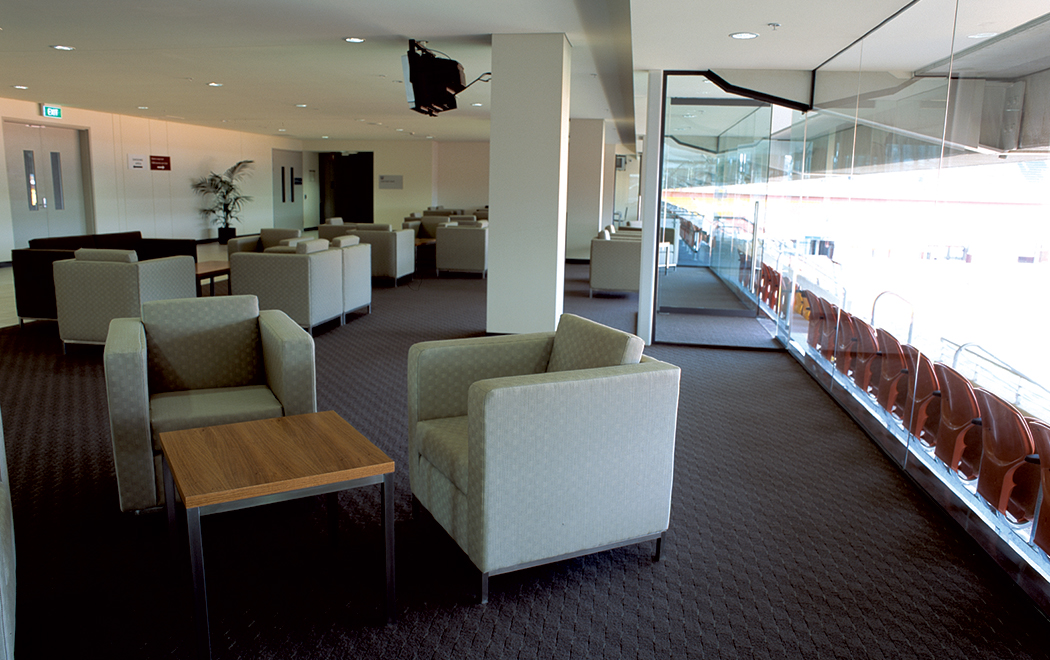
The prospect of the stadium’s expansion may have been welcomed by fans and players, but it was a different story for local residents, who feared that increased spectator noise would plague their neighbourhood. So the need to manage noise was driven from contrary directions – retaining atmosphere for the fans while reducing impact on the neighbours. The successful design solution was a low, flat, continuous steel roof, forming a vast ‘verandah’ overlooking the pitch.
This continuous roof provides shelter from sun and rain for 70 percent of the seating. Furthermore, the opportunity that such a large roof area offers for rainwater collection has been used to good advantage. The roof water discharges into box gutters which drain to a syphonic downpipe system that directs the water into two 200,000 litre steel tanks under the stadium, where it is drawn on for watering the pitch. This significantly reduces the facility’s draw on mains water supply.
The redeveloped Suncorp Stadium represents a culmination of the history of ‘Lang Park’. The slow organic process of development ended as soon as visions of redevelopment were sanctioned and master planning began. So while the cauldron atmosphere has been retained and enhanced to continue the Lang Park tradition, other demands of the project have irrevocably altered the place itself, despite promotional claims of minimising footprints and blending in with the surrounding area. Stadium design, at its most basic, is an architecture of crowd control. The need to provide rapid but safe ingress and egress for over 50,000 people has generated large concrete plazas to the north and south, which inevitably make the stadium an island.
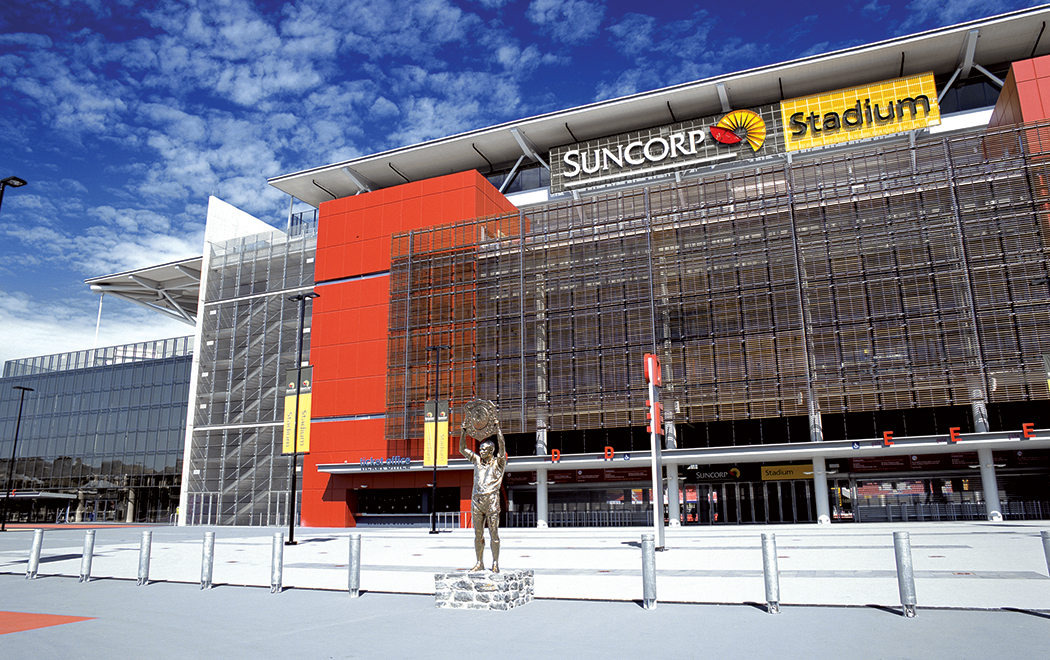
The linear arrangement of palm trees and a few other crow-resistant species in the northern plaza hardly constitutes ‘parklands’ as claimed by promoters. On the other hand this plaza does connect well with the restaurant precinct of Caxton Street, and also provides access to the soon-to-be-opened public basket/netball court and gym in the stadium’s northwest corner. So perhaps like the Lang Park of old, the open space will gradually be taken over by different activities and the place will take on a life of its own.
Perhaps the most incongruous outcome of the public consultation process is the retention and restoration of a still functioning Church (Christ Church Milton) and some gravestones within the new precinct, just metres from the stadium itself. The stadium looms over the modest timber 1890s church and vicarage, which used to be part of Chippendall Street that is no more, inescapably giving expression to the cliché that sport has become the religion of the modern age. But it is only a postmodern disposition that perceives this site-specific manifestation of the triumph of secularism as an ironic gesture – or perhaps sees no contradiction at all.
Project information
Architects
Project
Suncorp Stadium
Location
40 Castlemaine St, Milton QLD 4064 View on Google Maps
Copyright © 2003 BlueScope Steel Limited ABN 16 000 011 058. All rights reserved.
No part of this publication may be copied, reproduced or distributed without consent. BlueScope Steel Limited, to the extent permissible at law, is not liable to any person for loss or damage arising from reliance upon information contained in this publication. The articles featured in this edition of STEEL PROFILE® are sourced, written, fact-checked and curated by the authors with editorial contribution from BlueScope Steel Limited. Any statements or opinions attributed to a person are the views of that person alone and do not necessarily reflect those of BlueScope Steel. The decision to use any particular product or material in the projects featured in this publication was made by the team involved in each project and not BlueScope Steel Limited. While care has been taken to verify the accuracy of details in this publication, BlueScope Steel Limited assumes no responsibility or liability for any errors or omissions in the content of this publication. All information is provided with no guarantee of completeness or accuracy.
Images shown throughout have been reproduced to represent actual product colours as accurately as possible. However, we recommend checking your chosen colour against an actual sample of the product before purchasing, as varying screens and devices may affect colour tones and finishes.
Every project is different and not all products are suitable for all applications, projects and environments. You should confirm the suitability of particular products for your project by contacting the supplier directly and by obtaining information and advice specific to your circumstances.
To determine whether a BlueScope warranty may be available for use of a product in your particular project, please visit bluescopesteel.com.au/warranties.
BlueScope, COLORBOND®, GALVASPAN® and LYSAGHT® are registered trademarks of BlueScope Steel Limited.
Submit your project
We encourage you to share your projects for consideration in a future issue of STEEL PROFILE® magazine. We invite you to submit projects that feature a ground-breaking or an innovative use of steel. We love celebrating and writing about such projects!
Related projects